
Representational Systems
Visual, auditory, kinesthetic and auditory digital are the NLP representational systems. With example phrases and non-verbal signals to recognize them.
People don't just listen to words. They listen for the language in which they feel understood.
What Are Representational Systems in NLP
Representational systems are the perceptual channels through which each person makes contact with reality (seeing, hearing, feeling the body) and turns it into an internal representation, then communicated through words describing images, sounds and sensations. NLP identifies three main modes:
- Visual: processes information through mental images.
- Auditory: processes information through sounds and noises.
- Kinesthetic: processes information through bodily sensations, including taste and smell.
Every person has a preferred perceptual mode, which noticeably shapes how they express themselves at a given moment. It's important to remember these terms don't identify fixed types of people, but modes of communication: depending on the situation and context, the same person can show different preferences. They're, in a sense, like three different languages.
Why it matters
Recognizing which representational system a person is using at a given moment lets you speak more clearly, naturally and effectively, entering their way of organizing experience, not to manipulate it, but to reduce communicative friction. When this happens, understanding grows, rapport strengthens and resistance drops. A skilled communicator doesn't permanently label the people they talk to, but observes case by case which mode is most present, so the message lands more effectively.
How Representational Systems Work
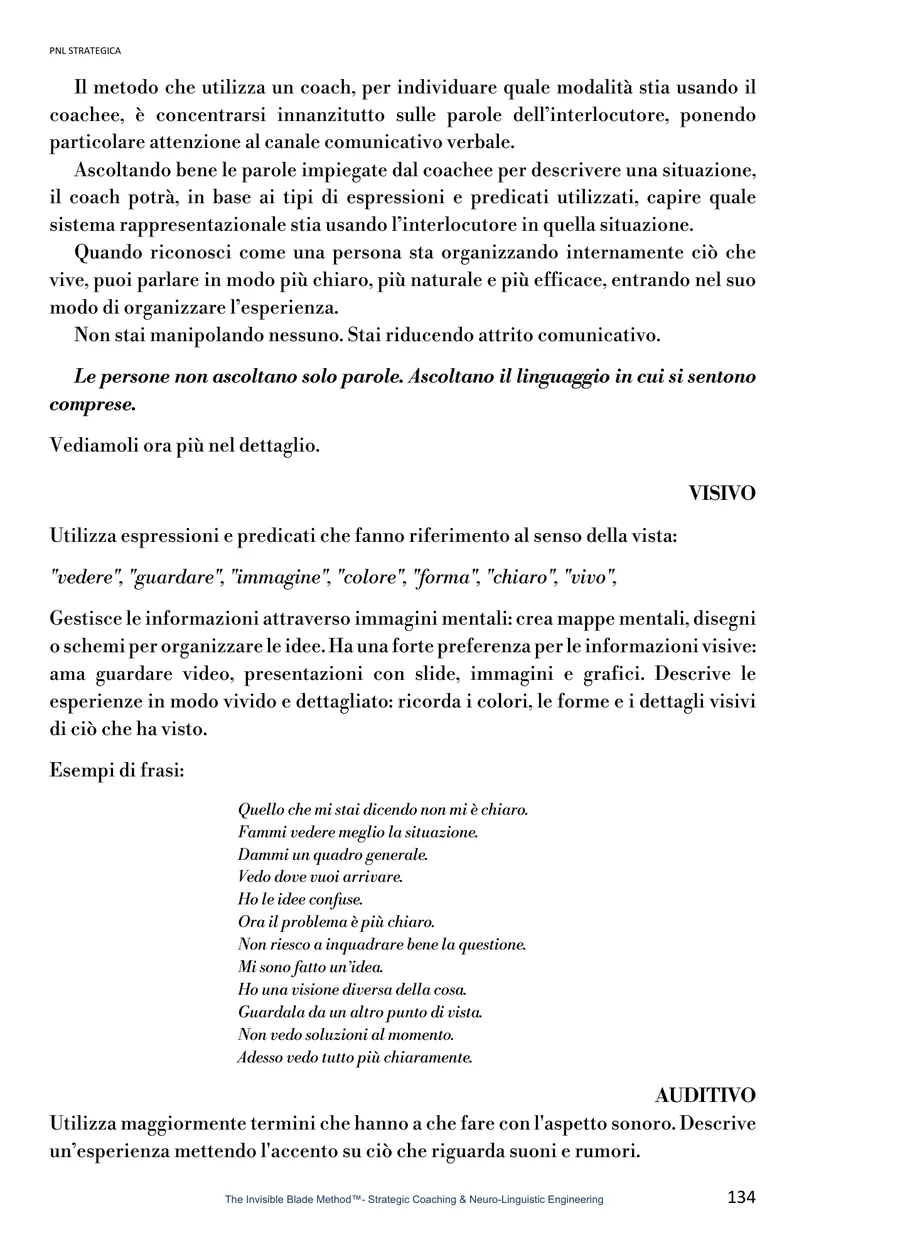
The main method for identifying a listener's representational system is listening carefully to their words, paying attention to the verbal predicates they use.
The visual type uses expressions like “see,” “look,” “picture,” “color,” “clear”: typical phrases are “it's not clear to me,” “let me get a better view of the situation,” “I see where you're going with this.” They process information through mental images, love slides, videos and diagrams, and describe experiences vividly and in detail.
The auditory type uses sound-related terms: “this sounds right to me,” “I don't like the tone you said that in,” “we're on the same wavelength,” “what you're saying really resonates with me.”
The kinesthetic type uses sensation-related terms: “I feel a strong tension,” “this situation weighs on me,” “that left a bitter taste,” “finally I can breathe.”
To more precisely distinguish which representational system is in use, listening to the words isn't enough: you also need to observe the non-verbal and paraverbal channels. In non-verbal terms, the visual type shows strong gesturing, with hands moving at face height almost as if drawing what they're describing, and tends toward high (chest) breathing; the auditory type has more moderate gestures, with hands moving centrally as if keeping time with the speech; the kinesthetic type often keeps their hands around abdomen height, with slower gestures and low (abdominal) breathing. In paraverbal terms, the visual type speaks quickly, often at high volume and a sharper tone, to keep pace with the images running before their eyes; the auditory type has a noticeable internal rhythm, with pauses marking time and well-emphasized key words; the kinesthetic type speaks slowly, often at low volume and a deep tone, with pauses that give them time to feel the sensations.
There's an additional system, considered a subset of the auditory one: digital auditory, which refers to internal dialogue. The main difference from “tonal” auditory lies in the internal representation: a digital auditory person mainly hears what they're telling themselves, comments on what's happening, and wants to know whether what they're observing is logical. They're characterized by complex, articulate sentences, focus on the precise meaning of words and the logical structure of the discourse, tend to break problems into smaller parts, organize ideas linearly, and appreciate defined terms and clear explanations. When a client describes a fear or limitation by saying “something tells me” or “I hear a voice telling me,” that's precisely digital auditory: internal dialogue.
Common mistakes
A common mistake is permanently labeling someone as “a visual” or “a kinesthetic,” forgetting these are communication modes that can vary from context to context, not personality categories. A second mistake is relying only on the verbal channel to identify the representational system, ignoring the non-verbal and paraverbal signals, which are often more reliable. A third mistake is confusing tonal auditory with digital auditory, which actually indicates a completely different mode, centered on internal dialogue.
Practical example
A coach listening to a client describe a problem with phrases like “I can't quite frame the issue, I'd like a clearer picture” recognizes a predominantly visual representational system. Responding in the same register, for example “let's try looking at the situation from another angle, to give you a clearer view of the available options”, the coach speaks the client's own “language,” reducing communicative friction and helping understanding, instead of responding in a predominantly kinesthetic language that would feel less natural for that person in that moment.
Applications
Recognizing representational systems applies to coaching, to adapt language to how the client organizes their experience; to sales, to present a product or service in the client's dominant perceptual register; to training and teaching, to make an explanation more accessible; and to building rapport in any personal or professional relationship.
Frequently asked questions
What are the three main representational systems in NLP?
Visual (images), auditory (sounds) and kinesthetic (bodily sensations, including taste and smell).
Do representational systems describe fixed types of people?
No. They're communication modes the same person can use differently depending on context, not rigid personality categories.
What is digital auditory?
It's a subset of auditory that refers to internal dialogue: the person mainly hears what they're telling themselves, comments on what's happening, and looks for logical consistency in what they observe.
How do you recognize a person's representational system?
By listening to the verbal predicates they use (words related to sight, hearing or sensation) and observing the non-verbal and paraverbal channels, like gestures, breathing, rhythm and tone of voice.
Why is it useful to recognize the other person's representational system?
Because speaking in the same perceptual register as the other person increases understanding, strengthens rapport, and reduces communicative resistance, so the message comes across as more natural and effective.
Related concepts
Eye Accessing Cues in NLP, Effective Communication, Internal Dialogue, Calibration: the Art of Measuring Human Signals, Rapport, Qualities of a Good Communicator, Metaprograms: How We Decide, What Is Neuro Linguistic Programming (NLP).
Go deeper
Representational systems, with complete examples of phrases and non-verbal and paraverbal characteristics, are presented in Volume I of “The Invisible Blade”.
Related articles

Strategic coach and mental coach. Author of The Invisible Blade – Strategic NLP series and creator of The Invisible Blade Method™.
Further reading to go deeper
If this topic interests you, these readings can help you go beyond the summary offered on this page.
NLP and modeling
Richard Bandler, John Grinder
Richard Bandler, John Grinder
Robert Dilts
Communication, relationship and influence
Paul Watzlawick and the Palo Alto School
Marshall B. Rosenberg
Figure from the reading path
- Bandler, R., & Grinder, J. (1975). The Structure of Magic I: A Book About Language and Therapy. Palo Alto, CA: Science and Behavior Books.
- Bandler, R., & Grinder, J. (1976). The Structure of Magic II: A Book About Communication and Change. Palo Alto, CA: Science and Behavior Books.
- O’Connor, J., & Seymour, J. (2000). Introducing Neuro-Linguistic Programming: Psychological Skills for Understanding and Influencing People. London: HarperCollins.
- Dilts, R. B. (1990). Changing Belief Systems with NLP. Cupertino, CA: Meta Publications.
- Clark, A. (2016). Surfing Uncertainty: Prediction, Action, and the Embodied Mind. Oxford: Oxford University Press.
- Varela, F. J., Thompson, E., & Rosch, E. (1991). The Embodied Mind: Cognitive Science and Human Experience. Cambridge, MA: MIT Press.
- Kahneman, D. (2011). Thinking, Fast and Slow. New York: Farrar, Straus and Giroux.
- Porges, S. W. (2011). The Polyvagal Theory: Neurophysiological Foundations of Emotions, Attachment, Communication, and Self-Regulation. New York: W. W. Norton.
- Navarro, J., & Karlins, M. (2008). What Every BODY Is Saying: An Ex-FBI Agent’s Guide to Speed-Reading People. New York: William Morrow Paperbacks.