
The Three Gates of Communication
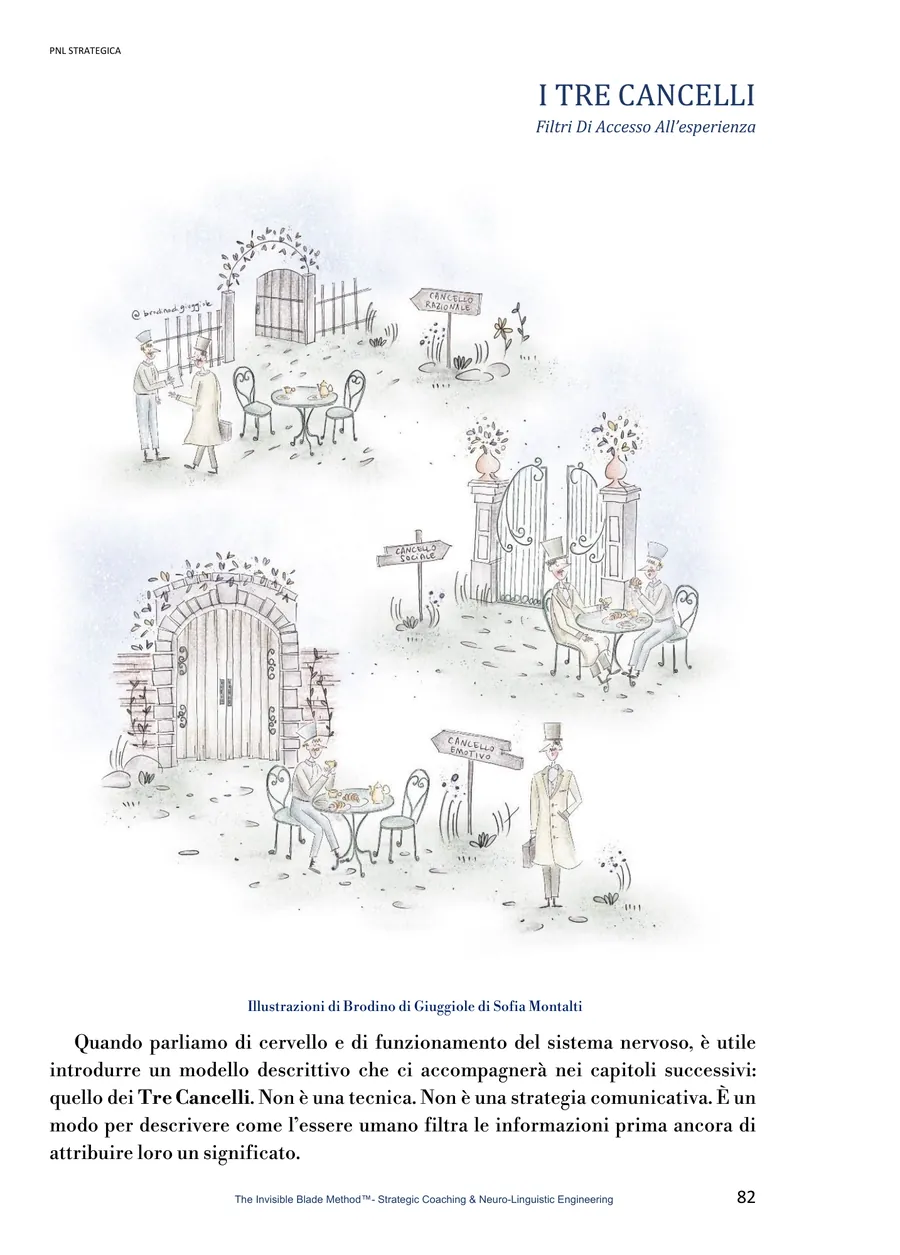
Instinctive, emotional and cognitive: these are the Three Gates in Giovanni Ceroni's NLP. Every effective communication starts here, and here is why.
We make decisions in a largely irrational way, but believe we made them rationally. Understanding the Three Gates means understanding how experience takes shape, before the person is even aware of it.
What it is
The Three Gates is a model describing how a human being filters information before even assigning it meaning. It's not a technique or a communication strategy: it's a description of how every external stimulus, verbal or non-verbal, gets evaluated by the brain before being processed consciously. This evaluation is fast, automatic and largely unconscious, and checks three fundamental conditions in sequence, each of which must be sufficiently satisfied before processing can move to the next level:
- The first gate, instinctive: checks for safety. It's the fastest level of the process, activating before thought and before conscious emotion. The implicit question is “am I safe? Friend or foe?” The brain registers simple, immediate signals (posture, distance, tone of voice, bodily tension) without analyzing the content of the message.
- The second gate, emotional: checks the relationship. The implicit question is no longer “what's happening” but “how do I feel in this interaction?” More subtle signals get registered: quality of presence, emotional tone, perceived intention, presence or absence of judgment.
- The third gate, cognitive: checks meaning. This is the level where the nervous system can devote resources to understanding, comparison and making sense of things. This is where conscious, rational processing of information happens, but it always comes last.
This sequence can't be reversed, not by communicative choice, but by neurophysiological design: only when the first two gates are sufficiently open does the third become genuinely accessible.
Why it matters
Understanding this model lets you read many communication difficulties not as a lack of ability, but as a lack of access: the problem often isn't what's being said, but which level it's being received at. The model helps clarify a basic point about human communication: evaluation happens first at the instinctive and emotional level, and only afterward does the rational part come into play, often to explain and justify a decision that's already been made, through confirmation bias. What we call “conscious choice” often arrives after a direction has already been set in motion.
How it works
When the first gate closes, meaning when the nervous system detects a warning signal, attention narrows and the body shifts into a defensive stance: cognitive resources get pulled away from processing and reallocated to defense. In this condition, what's being said loses relevance, not because it's wrong, but because it's not a priority. Only once this first check comes back reassuring enough can the system move toward a relationship, opening the second gate.
When the second gate is open, the body tends to relax, breathing regularizes and attention can stay stable: the person feels sufficiently acknowledged that they don't need to raise defenses. When it closes instead, the interaction continues in a limited way: the person stays present but not fully available, and the nervous system prioritizes protecting its own emotional footing over exploring new information. This corresponds to what Aristotle described as pathos: the emotional dimension of communication. Before convincing, you need to engage; before explaining, you need to create a favorable internal disposition.
When the third gate is open, the person can follow an argument, connect information, ask relevant questions: thinking can expand. This corresponds to Aristotle's logos: logic, argument, meaning. But it always comes last. When the third gate closes, understanding fragments, attention drops, the thread of logic gets lost, not from a lack of intelligence, but because the system isn't investing cognitive resources in that moment, to save energy.
A useful point to remember is that the mind always makes three basic decisions in the face of a stimulus: what to focus on, what meaning to give it, how to react to it. Changing a behavior without working on these steps is often ineffective.
Common mistakes
A common mistake is trying to convince someone with logical arguments (third gate) while the first or second gate is still closed: in this condition the content arrives, but doesn't get processed in depth, regardless of its quality. A second mistake is reading a closed gate as a personal rejection or a lack of intelligence, when it's actually an automatic protective function of the nervous system, not a pathological one. A third mistake is ignoring the order of the sequence, trying to skip straight to the cognitive level without first establishing safety and relationship.
Practical example
A manager gives a team member, in a brusque tone and standing over their desk, a series of very rational arguments for why a project needs revising. If the manager's tone and posture trigger a threat assessment at the team member's first gate, the whole argument, however correct on the merits, won't really get processed: the team member's cognitive resources will be tied up in defense, not understanding. The same content, delivered in a calm tone, with respectful eye contact and a sense of not being judged, would have a much better chance of passing through the first two gates and genuinely reaching the third, where it can be understood and discussed.
Applications
The Three Gates model is referenced as an operational touchstone throughout effective communication, relationships and influence, conflict management, public speaking, and any change process: before delivering content, it helps check whether the person in front of you is in the neurophysiological condition to receive it.
Frequently asked questions
What are the Three Gates in NLP?
They're a model describing the automatic sequence through which the nervous system filters every external stimulus before assigning it meaning: first it checks safety (instinctive gate), then relationship (emotional gate), finally meaning (cognitive gate).
In what order do the Three Gates open?
Always in the same order: first the instinctive gate (safety), then the emotional one (relationship), finally the cognitive one (meaning). This sequence can't be reversed, due to how the nervous system is wired.
Why does the third, rational gate always come last?
Because the nervous system only allocates resources to cognitive processing after verifying the situation is safe and the relationship is sufficiently open. It's the most energy-expensive level, so it's the most protected.
What happens when the first gate closes?
Attention narrows and the body shifts into a defensive stance: cognitive resources get pulled away from processing the content and reallocated to protection, regardless of how good or correct what's being communicated is.
How does the Three Gates model connect to effective communication?
It helps explain why logically correct arguments sometimes don't land: if the first two gates aren't open, the message never reaches the cognitive level where it could be understood and evaluated for what it is.
Related concepts
Opening the Three Gates in Communication, How the Brain Works (and Why Change Is So Hard), Effective Communication, What Is an Internal State, Rapport.
Go deeper
The Three Gates model is presented in Volume I of “The Invisible Blade”, and is picked up as an operational foundation in Volume II, where Giovanni Ceroni uses it as a constant reference point for tools that work on internal structure.
Related articles

Strategic coach and mental coach. Author of The Invisible Blade – Strategic NLP series and creator of The Invisible Blade Method™.
Further reading to go deeper
If this topic interests you, these readings can help you go beyond the summary offered on this page.
NLP and modeling
Richard Bandler, John Grinder
Richard Bandler, John Grinder
Robert Dilts
Communication, relationship and influence
Paul Watzlawick and the Palo Alto School
Marshall B. Rosenberg
Figure from the reading path
- Aristotle. (2007). On Rhetoric: A Theory of Civic Discourse (G. A. Kennedy, Trans.). New York: Oxford University Press. (Original work ca. 4th century BCE).
- Goleman, D. (1995). Emotional Intelligence. New York: Bantam Books.
- Kahneman, D. (2011). Thinking, Fast and Slow. New York: Farrar, Straus and Giroux.
- LeDoux, J. (1996). The Emotional Brain: The Mysterious Underpinnings of Emotional Life. New York: Simon & Schuster.
- MacLean, P. D. (1990). The Triune Brain in Evolution: Role in Paleocerebral Functions. New York: Plenum Press.
- Porges, S. W. (2011). The Polyvagal Theory: Neurophysiological Foundations of Emotions, Attachment, Communication, and Self-Regulation. New York: W. W. Norton.
- Sapolsky, R. M. (2004). Why Zebras Don’t Get Ulcers (3rd ed.). New York: Henry Holt.
- Siegel, D. J. (2012). The Developing Mind (2nd ed.). New York: Guilford Press.