
The Carriage Metaphor
Body, horses, coachman and passenger. Gurdjieff's carriage metaphor, read through NLP, becomes a map for understanding the person.
Every idea, every technique, every change always acts on something concrete: the person. And the person isn't just the biological body or the sum of visible behaviors, but the way experience gets organized internally.
What Is the Carriage Metaphor
The carriage metaphor is a model, drawn from the Armenian philosopher and mystic G.I. Gurdjieff, that describes the complex nature of a human being through four elements:
- The carriage — the physical body: the most tangible part of ourselves, the vehicle through which we interact with the outside world and live sensory experience. It's subject to the laws of physics and nature, and needs care, rest and maintenance. Ignoring its needs compromises the whole path.
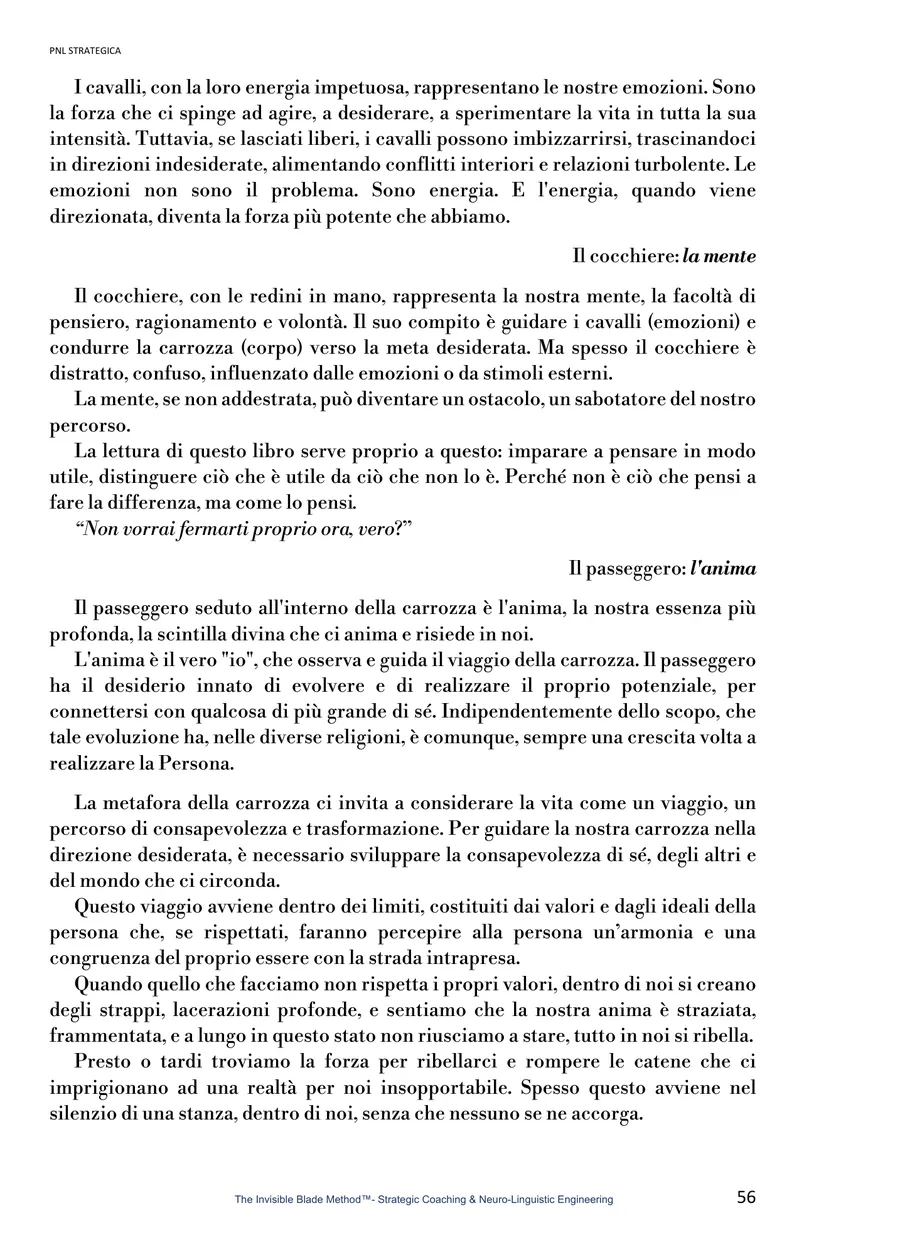
- The horses — the emotions: the force that drives us to act, to desire, to live life with full intensity. Left unchecked, the horses can bolt, dragging the carriage in unwanted directions. Emotions aren't the problem: they're energy, and energy, once directed, becomes the most powerful force we have.
- The coachman — the mind: the faculty of thought, reasoning and will, holding the reins and tasked with guiding the horses and steering the carriage toward the desired destination. If untrained, the coachman can be distracted, confused, swayed by emotion or external stimuli, becoming an obstacle instead of a guide.
- The passenger — the soul: the deepest essence, the true “I” who observes and directs the path, with an innate desire to evolve and realize its own potential.
Why it matters
This metaphor matters because it offers a complete, immediate map of how human beings function, one that can guide any coaching or personal growth intervention: before working on a problem, it helps to ask which part of the carriage is actually being addressed, the body that needs care, the emotions that need directing, the mind that needs training, or alignment with one's deepest values.
The path always unfolds within limits set by the person's values and ideals. When these values are respected, the person feels harmony and congruence between who they are and the path they're on. When what they're doing doesn't respect their own values, internal fractures form, and sooner or later the force emerges to break the chains of a reality perceived as unbearable.
How the Carriage Metaphor Works
Each of the four components requires a different kind of intervention. The body stays healthy through nutrition and exercise, and needs to be taken beyond mere survival, toward a condition of vitality, flowing with abundant energy. Emotions shouldn't be repressed, nor left free to drag the carriage wherever they want, but consciously directed. The mind needs to be trained to think usefully, distinguishing what's useful from what isn't: it's not what you think that makes the difference, but how you think it. The soul, finally, orients the whole path toward what NLP calls “the best version of yourself”: a continuous process of improvement lived with the desire and eagerness of self-discovery, without the weight and anxiety of the outcome.
In this framework, the coach's job isn't to create something that doesn't exist in the person, but to free a better version that's already present and waiting to emerge. And to truly free something, wanting it isn't enough: you need to understand what's holding it back.
Common mistakes
A common mistake is addressing only one component of the carriage while ignoring the others: for example, working on mental motivation (the coachman) while the body (the carriage) stays neglected, or while the emotions (the horses) remain completely unmanaged. A second mistake is thinking that repressing emotions is the same as governing them: the horses shouldn't be blocked, they should be guided. A third mistake is confusing a coach's work with adding something to the person, when really it's about removing what's preventing an already-present version from emerging.
Practical example
A person wants to feel more confident in work meetings. If they work only on the mind, repeating motivational phrases before going in, while the body stays tense with shallow breathing, and the emotions of anxiety stay unmanaged, the change will be fragile. Applying the carriage metaphor, the work proceeds on multiple levels: physiology is addressed (posture, breathing), emotions are recognized and directed instead of denied, the coachman's internal dialogue is trained, and the goal (speaking with confidence) is checked against the person's deeper values (the passenger).
Applications
The carriage metaphor applies to any coaching and personal growth path as an initial orientation map, to understand which level (physical, emotional, mental or values-based) is most useful to work on at a given moment; to stress management, where the most effective intervention often starts with the body before the mind; and to supporting deeper change processes, where the conflict between what one does and one's own values generates the real push toward change.
Frequently asked questions
Who came up with the carriage metaphor?
The metaphor was used by the Armenian philosopher and mystic G.I. Gurdjieff to illustrate the complex nature of human beings and their path of personal growth.
What do the four elements of the carriage metaphor represent?
The carriage represents the physical body, the horses the emotions, the coachman the mind, and the passenger the soul, the person's deepest essence.
Why are emotions compared to horses instead of a problem to eliminate?
Because emotions aren't the problem: they're energy. Like horses, if left without guidance they can drag things in unwanted directions, but once directed they become the most powerful force available to the person.
What happens when the mind, the coachman, isn't trained?
It becomes an obstacle instead of a guide: distracted, confused, easily swayed by emotions or outside stimuli, instead of steering the carriage toward the desired destination.
What does “the best version of yourself” mean in this model?
It's a continuous striving toward personal improvement, experienced not as the weight or anxiety of an outcome, but as a desire for self-discovery. It's described as already present within the person: the coach's job isn't to create it, but to help it emerge.
Related concepts
What Is an Internal State, How the Brain Works (and Why Change Is So Hard), Emotions in NLP, Internal Dialogue, Coaching.
Go deeper
The carriage metaphor is presented in the “The Person” chapter of Volume I of “The Invisible Blade”, as the entry point to the following work on how the mind, emotions and communication function.
Related articles

Strategic coach and mental coach. Author of The Invisible Blade – Strategic NLP series and creator of The Invisible Blade Method™.
Further reading to go deeper
If this topic interests you, these readings can help you go beyond the summary offered on this page.
Body, presence and personal growth
G. I. Gurdjieff
Jon Kabat-Zinn
Figure from the reading path
- Bandler, R., & Grinder, J. (1975). The Structure of Magic I. Palo Alto, CA: Science and Behavior Books.
- Deci, E. L., & Ryan, R. M. (2000). The “What” and “Why” of Goal Pursuits: Human Needs and the Self- Determination of Behavior. Psychological Inquiry, 11(4), 227–268.
- Frankl, V. E. (1946). Man’s Search for Meaning. Boston: Beacon Press.
- Gurdjieff, G. I. (1950). All and Everything: Beelzebub’s Tales to His Grandson. New York: Harcourt Brace.
- Kahneman, D. (2011). Thinking, Fast and Slow. New York: Farrar, Straus and Giroux.
- Maslow, A. H. (1954). Motivation and Personality. New York: Harper & Row.
- Rogers, C. R. (1961). On Becoming a Person. Boston: Houghton Mifflin.